










SMD vs. COB LED Strip Lights: What’s the Real Difference?
SMD vs. COB LED Strip Lights: What’s the Real Difference?
By Jimmy Zhang, Lighting Specialist at Rishang | Published 2026/11/13
The short answer: SMD and COB LED strips now come in the same colors and with the same controls, including RGB, RGBW, dual color temperature, dim-to-warm, group control and pixel control. What really separates them is how the light looks and what you pay for it.
SMD uses larger chips, so it reaches higher efficacy (up to about 220 lm/W) and costs less, but you can see individual dots unless the strip is hidden or diffused. COB uses many small chips under one phosphor layer, so it glows as one smooth line, but its efficacy tops out lower (about 160 lm/W) and the price is higher. If the strip is out of sight, buy SMD. If people will see it up close, buy COB.

SMD Strip Lights
Why most buyers get this wrong
Most people find two strips that look almost identical in the photos, with one costing twice as much. One listing says “COB” and the other says “2835” or “5050,” and nobody explains what that means. I’ve installed, specified and troubleshot a lot of LED strip, and the usual regret goes one of two ways: people put bare SMD on a visible edge and hate the dots, or they pay extra for COB on a hidden run where nobody would ever see the difference.
Both are good products. Once you understand one idea, chip size, the rest of the comparison falls into place.
The one idea that explains the difference: chip size
An SMD strip (surface-mounted device) uses individually packaged LEDs placed on the flexible circuit board by machine. The number in the name is the package size in millimeters: 2835 (2.8 × 3.5 mm) is the workhorse for white strips, 5050 is larger and common on RGB and RGBW strips, and 3528 is an older, dimmer type. A strip has roughly 18 to 72 LEDs per foot (60 to 240 per meter), and each one uses a relatively large chip.
A COB strip (chip-on-board) mounts rows of bare, much smaller chips directly on the board and covers them with a continuous phosphor coating. Density runs roughly 100 to 342 chips per foot (320 to 1134 per meter).
Large chips spaced apart give you SMD’s strengths and weaknesses: more efficient and cheaper, but visible dots. Many small chips packed tightly give you COB’s: a smooth line, but a lower efficacy ceiling and a higher price. Everything below follows from that.

COB Strip lights
Difference 1: How the light looks
This is the one you’ll notice first. With SMD there is space between each LED, so an exposed strip shows hotspots. COB has no gaps, so it looks like a continuous line from a few inches away, and its beam angle is typically wider (around 140° versus 115° for SMD).
Dots depend on distance, not just density. A 120 LED/m SMD strip tucked behind a ledge looks fine, while the same strip on an exposed shelf edge looks like a string of beads. Diffusion fixes more than people expect: an aluminum channel an inch or more deep with a frosted cover makes SMD look surprisingly smooth. If you’re on the fence, try a diffuser on a good SMD strip before paying up for COB.
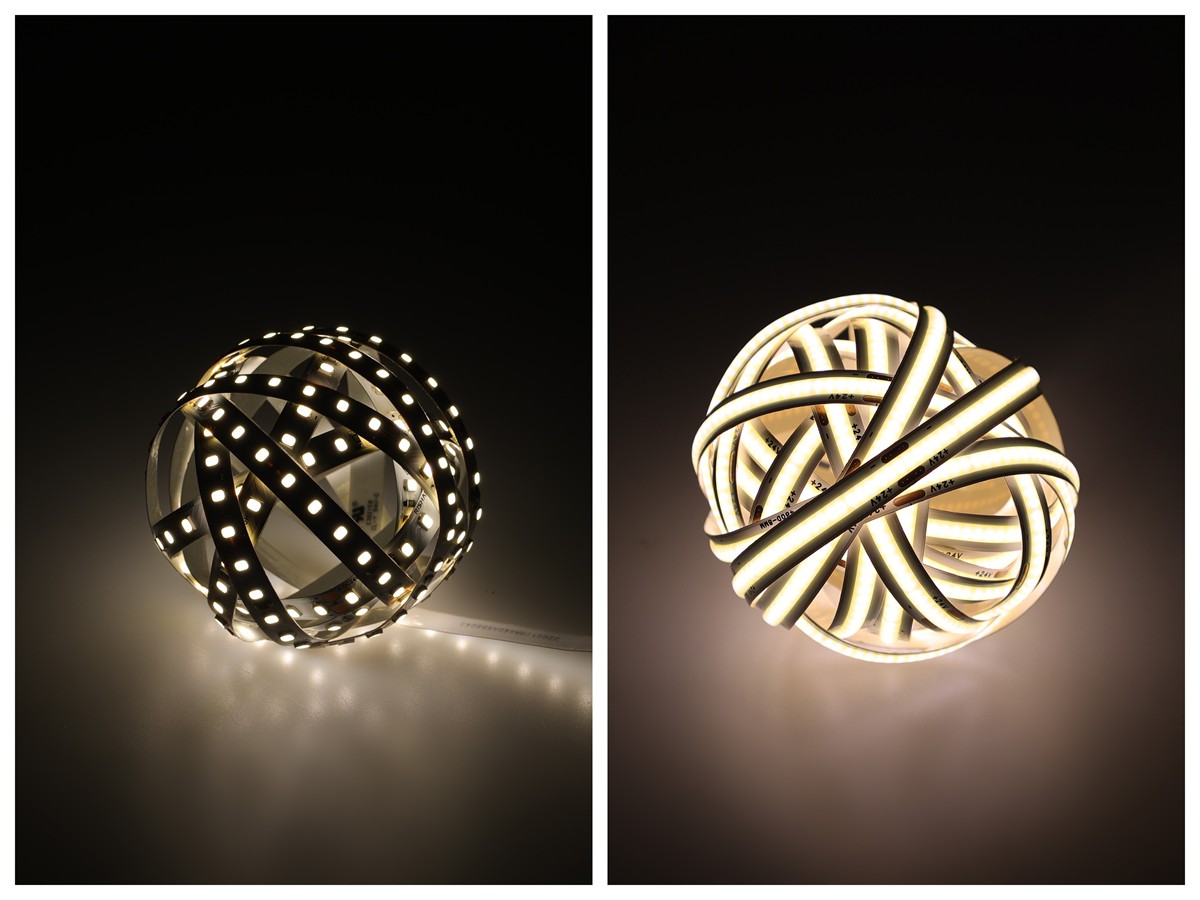
SMD & COB LED Strip Lighting
A special case: concealed White and Black COB strips
There is one thing COB can do that a standard strip can’t: nearly disappear. Some COB strips are made entirely white or entirely black, with the circuit board and the coating in the same color. Stick a white one on a white surface, or a black one on a black surface, and the strip itself is hard to spot even up close, so all you see is a clean line of light.
That makes them a good fit for linear lighting where you want the effect and not the hardware: white wall corners, cabinet edges, closet interiors, white shelving, and black frames or dark millwork. Because COB has no dots, you don’t need a deep channel or a diffuser to hide the pattern, and the strip is thin enough to run along an edge. Most are also self-adhesive, so installation is mostly peeling and sticking.

As an example, Rishang RM0812EC-JL-W1 White COB is 8 mm wide with 480 chips per meter at 24V and 10 W/m. It has CRI 90+, SDCM ≤3 and a 3M adhesive backing, and comes in 2700K, 3000K, 4000K and 6500K, with IP20 or an IP65 silicone tube on request.
One tip: match the strip to the surface. A white strip on a cream, gray or wood surface will read as a pale stripe, so concealed strips work best against a true white or true black background.
Difference 2: Efficacy, brightness and heat
Because SMD can use larger chips, the best SMD strips reach up to about 220 lm/W (Rishang RV00J0DC), while the best COB strips today reach about 160 lm/W (Rishang RM0846MC-V1). Those are best-case numbers, and plenty of strips on the market fall well below them, so check the datasheet for the exact product. Compare lumens per foot and lumens per watt, not LED count or watts alone.
Higher efficacy means less wasted heat for the same brightness, which helps on long, high-output runs. Heat matters for both types, though. Mounting either one on aluminum channel helps it shed heat and last longer, especially at higher wattage.
Difference 3: Price and handling
SMD usually costs less per foot, and the gap adds up on big runs. COB is thinner and often more flexible, so it fits tight spaces and narrow channels more easily. Cut points depend on the product. SMD is typically cut every 1–2 in on 12V or 2–4 in on 24V, depending on density, and COB is often every 1–2 in.
Repairs are similar for both. SMD LEDs run in small series groups, so one dead LED usually takes out the whole group (3 LEDs on a 12V strip), and a failed COB section tends to go dark in a block. In both cases the practical fix is cutting out the dead section and reconnecting.
What’s no longer different: colors and controls
This used to be a reason to pick SMD, but it isn’t anymore. Both types are available in single color, dual color temperature, dim-to-warm, RGB and RGBW, and both support group control and pixel (individually addressable) control. If a listing suggests you have to pick one type to get a feature, check the specific product instead of assuming.

SMD vs. COB at a glance
| SMD LED strip | COB LED strip | |
|---|---|---|
| Light source | Individually packaged LEDs, larger chips | Bare small chips under one phosphor layer |
| Density | About 18–72 per foot | About 100–342 per foot |
| Look when exposed | Visible dots or hotspots | Smooth, continuous line |
| Beam angle | Typically around 115° | Typically around 140° |
| Efficacy (best available) | Up to about 220 lm/W | Up to about 160 lm/W |
| Colors and controls | Dual color temp, dim-to-warm, RGB, RGBW, group and pixel control | Dual color temp, dim-to-warm, RGB, RGBW, group and pixel control |
| Thickness | Slightly thicker | Thinner, often more flexible |
| Price | Lower | Usually higher |
The efficacy figures are best-case. Check the spec sheet for the exact strip you’re buying.

Which one should you buy?
Start with one question: will anyone see the strip itself, or only the light it casts?
- Hidden or diffused (cove, behind a TV, toe kick, frosted channel): SMD. You get higher efficacy and a lower price, and nobody sees the dots.
- Visible up close (open shelves, glass display shelves, stair edges, mirror frames): COB, for the smooth line without a thick diffuser.
- Under-cabinet kitchen lighting: COB if the strip is visible from the side or reflects off a shiny countertop. SMD in a diffused channel if it’s tucked behind a lip.
- Closets and display cases: COB, warm to neutral white, CRI 90+.
- Long runs or tight budgets: SMD. The savings and efficacy add up.
- Tight spaces and narrow channels: COB, because it’s thinner.
- Color or pixel effects (TV backlight, gaming setups): Either type works. Choose SMD if the strip is hidden and COB if it’s visible.
- Outdoor eaves, patios, landscape: Either one, as long as it’s rated IP65 or higher and sealed at the ends and connections.

Specs that matter for either type
Once you’ve picked SMD or COB, these decide whether the install goes well.
- Voltage. On a 12V strip the far end gets dimmer and warmer after roughly 16 feet. 24V handles longer runs much better. For anything big, use 24V and feed power from both ends or in parallel segments.
- CRI. 90+ for homes and retail, where wood tones, food and skin should look natural. 80 is fine for utility spaces. Look for brands that bin their LEDs well so one reel doesn’t look pinker than the next.
- Color temperature. 2700K–3000K is warm, 3500K–4000K is neutral, 5000K+ is cool. Pick one and stay consistent within a room.
- IP rating. IP20 for dry indoor spaces, IP65 for kitchens, baths and covered outdoor areas, IP67 or IP68 for wet locations.
- Power supply. Load it to no more than about 80% of its rating, and look for a UL or ETL listing.
- Dimming compatibility. Make sure the driver and dimmer actually work together. Flicker usually comes from mismatched parts, not the strip.
- Warranty. A real warranty tells you the maker expects the product to last.
Frequently asked questions
Which is better, SMD or COB LED strip lights?
Neither is better overall. SMD costs less and reaches higher efficacy, and it works best when hidden or diffused. COB looks smoother when the strip is visible.
Are COB LED strips brighter than SMD?
Not necessarily. Brightness depends on wattage, chip quality and efficacy. SMD can use larger chips and reaches higher efficacy, up to about 220 lm/W versus about 160 lm/W for COB. COB’s advantage is how evenly the light spreads.
Why do my LED strips look dotted?
That’s the visible spacing between individual LEDs. A deeper channel, a frosted diffuser, or moving the strip farther from the surface fixes it. Or switch to COB.
Can you cut COB LED strips?
Yes. Cut only at the marked cut points, usually shown with a scissor icon, and use a compatible connector or solder the wires back on.
How long do LED strips last?
Quality strips are commonly rated for 25,000 to 50,000 hours. In real life, power supply quality, heat and installation matter as much as the strip itself.
The bottom line
Colors and controls no longer decide this, so it comes down to three things: how the light looks, how efficient it is, and what it costs. SMD is the higher-efficacy, lower-cost choice when the strip is hidden or diffused. COB is the smoother-looking choice when people can see the strip. Pick by where the strip will go, then get the voltage, CRI and IP rating right and either type will serve you well.
Disclosure: Rishang sells both SMD and COB LED strips. This guide is meant to help you choose whichever fits your project.
About the author: Jimmy Zhang is a Lighting Specialist at Rishang with 21 years of hands-on experience with LED strip lighting, from under-cabinet kitchen installs to large cove projects. He writes about strips, power supplies and lighting design in plain language.
Let’s talk about your project
Tell us what you’re trying to light. We’ll help you find the right solution.
Contact Us


